Featured Artists

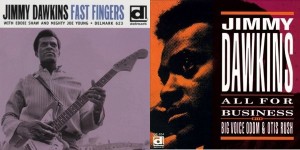
Jimmy Dawkins, a prominent Chicago blues figure for over four decades, passed away April 10, 2013, at age seventy-six. Dawkins was born in Tchula, MS, but spent much of his childhood in the gulf coast area of the state, in Pascagoula, where his father was employed in shipbuilding through the years of World War II. The music of New Orleans was prominent throughout the gulf coast, and Dawkins grew up as much with that music as with traditional Mississippi blues.

Dawkins taught himself guitar, starting with a guitar that belonged to an uncle who lived with the family for a while, and in the mid 1950s moved to Chicago, playing in clubs while working a day job in a box factory. After a few years he was able to support himself with performing, and he was mentored by the great Magic Sam (Sam Maghett), who brought him to the attention of Delmark Records.

Dawkins’ 1969 debut album, recorded for Delmark, is called “Fast Fingers.” The album’s title became his nickname thereafter, though Dawkins disliked it. For one thing, although he could play fast, there were others who were faster. More importantly, his view of guitar-playing was more balanced and nuanced, and simple speed, in his thinking, was only one component of guitar mastery. He became known as an exponent of the “West Side style” of Chicago blues, more modern and urban (perhaps reflecting his New Orleans influences) than the rougher sound closely based on traditional Mississippi blues, the “South Side style.”

The “Fast Fingers” album won an award, years before the Blues Foundation was in existence with its awards, or the Grammy awards for the blues category had been created; Dawkins received a Grand Prix du Disque de Jazz from the Hot Club of France. Dawkins was not a great blues singer, and he sometimes chose to perform and record with stronger singers such as Andrew “Big Voice” Odom, who sings on his “All For Business” album on Delmark Records. His popularity in Europe was very beneficial for him when the blues scene in America went into eclipse in the 1970s and 80s and club work and recording opportunities diminished here. He played extensively in Europe, and recorded for European labels, including an album of recordings in Iceland. In the 1990s, he started recording for domestic labels again, including Ichiban, Fedora, and Earwig.

Dawkins had a fondness for unorthodox spelling; he had albums called “B Phur Real” and “Kant Sheck Dees Bluze” and spelled “guitar” in song titles variously as “gitar” and “gittar.” He felt that the spellings called attention to the songs, though some record companies “corrected” them. Dawkins liked blues to be improvisational and spontaneous, and he typically eschewed rehearsal, even in the songwriting process, which often was simply a matter of making up a title and then building the song to match it while actually recording it. To be sure, this did not result in his being one of the great songwriters of the blues, but his performances in the studio do have a fresh and uncontrived feel to them.

Dawkins put many of his songs in the names of his grandchildren so that royalties would go directly to them. He helped artists and their heirs collect unpaid royalties through his Leric Music company, and his Leric label was an avenue for him to record artists he felt deserved to be heard, including Queen Sylvia Embry, Little Johnny Christian, and Tail Dragger. In fact, one of Dawkins’ better songs, “So Ezee” (another creative spelling), has been a staple for Tail Dragger, appearing on two of his albums following his recording for the Leric label.

Dawkins wrote articles for several of the blues magazines, talking up artists he thought were deserving, and served with the planning group for the annual Chicago Blues Festival. The windy city, and the rest of the blues world, have been lucky to have his talent, energy, and love for the blues in play for all these years.

{ 0 comments }

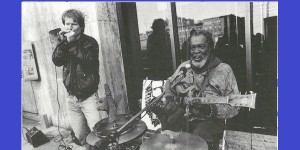
Adam Gussow is one of the world’s finest blues harmonica players. He became known, and celebrated, in the 1990s as part of a duo that was one of that decade’s most exciting and intriguing acts, Satan & Adam. “Mr. Satan” sang and played guitar and drums simultaneously with the energy of an Olympic athlete, and a distinct guitar chord style based very creatively on the use of open strings while fretting the instrument on its higher frets. Mr. Satan lived in Harlem, and Satan & Adam emerged as a street act in Harlem at the end of the 1980′s, eventually appearing at other New York City locations and finally at clubs and festivals around the world. They appear briefly in U2′s “rockumentary” Rattle And Hum.

In the early days Adam had to prove himself to the Harlem audience, which he did, as one of the few players who were playing a lot of “overblow” notes on the harmonica – that is, producing pitch changes by strong and very precisely controlled changes in the air blown into the instrument. Coming from different racial, economic, and cultural backgrounds, Mr. Satan and Adam Gussow became friends and partners in blues, making three albums in the 1990s through several years of frenetic playing and traveling that eventually led to major scares for both: a mild heart attack for the young and physically active Gussow, and a nervous breakdown for the older and preternaturally-inspired Mr. Satan.

Gussow still occasionally plays with Mr. Satan, who these days will respond to his given name Sterling Magee. He also plays solo and with other musicians, but the Princeton-educated harp player (who obtained both an undergraduate and PhD degree there) is also a perceptive commentator on the scene and the culture of the blues, a celebrated author, and a professor in the English Department, at – of all schools – Ole Miss, The University Of Mississippi.

The position of professor at Ole Miss with an appointment in the Center For Southern Culture and the English Department was a dream job for Gussow. “I was looking for a tenure-track job, and I got the job at The University of Mississippi,” says Gussow. “Who wouldn’t want that? What blues harmonica player in his right mind doing what I was doing academically wouldn’t want that posting, right?” Surprisingly, none of the full-time English professors at Ole Miss are Mississippi natives (William Faulkner and Eudora Welty may be rolling over in their graves).

Mississippi is famous for all of the blues players who left the place, often for Chicago, but Gussow, a New York native and blues player, reversed the pattern by moving TO Mississippi. In his books and articles, Gussow has proved to be an astute observer of the blues phenomenon and its many contradictions. Contradictions and unexpected outcomes did not end for Gussow with his appointment as a professor. Expecting that he would be playing lots of music, he found that he actually wasn’t, for several years, because the “hill country” blues in the area around the university wasn’t his sound or his experience. He laughingly says the style is summarized by a Junior Kimbrough album title, “Most Things Haven’t Worked Out.” “My wife and I used to joke,” says Gussow. “We’d call it ‘shoot-me now music.’” Gussow has since gotten into it more.

I spoke with Adam Gussow by telephone on April 11, 2013, and, as always, enjoyed the unique insights and stories from his singular history as a player and a scholar of the blues. The wide-ranging discussion of Mississippi music, politics, economics, history, and culture is presented here; it runs just under twenty-five minutes, and I think you’ll like it! [Listen to my conversation with Adam Gussow]

Books by Adam Gussow:

Seems Like Murder Here: Southern Violence and the Blues Tradition by Adam Gussow (Chicago: University Of Chicago Press, 2002)

Journeyman’s Road: Modern Blues Lives from Faulkner’s Mississippi to Post-9/11 New York. (Knoxville: University of Tennessee Press, 2007)

Mister Satan’s Apprentice: The story of an Unlikely Musical Partnership, The Blues, and Race in America (Minneapolis: University of Minnesota Press, 2009)

Check out Adam Gussow’s Modern Blues Harmonica site, the ultimate resource for people who want to hear, learn about, or learn to play blues harmonica.

{ 0 comments }

In 2008, it was “M For Mississippi: A Roadtrip Through The Birthplace Of The Blues.” Jeff Konkel and Roger Stolle visited clubs and homes in Mississippi to bring us the music, and the stories, of a number of modern rural Mississippi blues artists. In 2011, they made another trip around the state, this time surveying the state of juke joints and blues clubs. The film “We Juke Up In Here” revealed a sharp decline in the number of these places and a change-over, in some that were still in operation, from live bands to dee-jays.

Now Konkel and Stolle are returning with a new concept, and a more upbeat message, a “reality show” about modern Mississippi blues! “Moonshine & Mojo Hands” is planned as a weekly web-TV series about present-day Mississippi blues. Konkel and Stolle will do it again – namely, travel around the Magnolia state and introduce us to blues artists playing at various venues and house parties. They promise to tell the story as it is, without embellishment or cosmetic editing. The music, the food, the places, and of course the people that make up the exciting and often quirky blues scene in Mississippi will be the subjects of this weekly series. Each online episode will run twelve minutes, and there won’t be any “filler.” The first season will have ten episodes, streaming online for free.

Konkel and Stolle still need some financial backing, and they are seeking it in a totally modern way, with a Kickstarter campaign.

{ 0 comments }

Arthur “Big Boy” Crudup shares with Robert Johnson and some other blues greats the unfortunate fact (from a blues-centric perspective anyway) of being known today primarily because of their influence to rock stars. Johnson is known for his influence to Mick Jagger and the Rolling Stones as well as Eric Clapton and Cream, while Crudup (pronounced “Crude-up”) is remembered for his influence to Elvis Presley. Presley recorded three of Crudup’s songs, most famously, “That’s All Right,” which was his first commercial release on Sun Records in 1954.

By that time, Crudup’s fame in the blues world was actually ebbing, but he enjoyed substantial popularity, mostly among blacks, between 1941 and the early 1950s. The native of Forest, MS, arrived in Chicago sometime in the later 1930s and did not find life easy there. He apparently lived in a packing crate under the 39th Street L for at least a short time. Success on the Bluebird label did not translate to riches though it was helpful to him. Neither did “That’s All Right” generate money for him, and he wasn’t able in his lifetime to collect royalties.

The question of whether Crudup really wrote the song is a fair one. I’m not an intellectual property lawyer, but I can safely say that the title verse of the song is drawn directly from Blind Lemon Jefferson, from a song called “That Black Snake Moan” recorded in 1926. Jefferson was immensely popular and Crudup undoubtedly knew his songs.

Many of Jefferson’s songs have no coherent story or idea in them. Writers have used terms like “athematic” or talked about “stanzaic disjunction” to describe songs whose verses seem to have nothing to do with one another in any logical way. Many memorable Jefferson verses would be adopted by later blues players and used to build a song that did actually tell a story or have a central idea to it. The title verse of “That’s All Right” was also sung at Carnegie Hall by Big Joe Turner in 1938′s “From Spirituals To Swing” concert, where the song was called “It’s All Right Baby,” so it was certainly around before Crudup’s 1946 recording that Presley covered. Still, Crudup’s story and additional verses for the song seem to be his own.

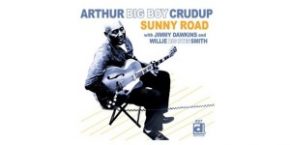
In the 1960s, Crudup got some benefit, though hardly enough, from the blues and folk revival. He recorded a couple of albums for Delmark Records. The tracks on the recently issued “Sunny Road” are also on that label, though they have been sitting on a shelf since 1969. Like “That’s All Right” these songs draw verses and lines from the great wealth of blues songs before them, including “Eyesight To The Blind” and “Dust My Broom.” It’s not entirely surprising that they have not been issued before. As it is, by the 1960s Crudup’s songs on albums seemed to have a sameness to them. That is also the case with “Sunny Road” although there is an interesting wrinkle – – on most of the songs, Crudup’s guitar runs through a Leslie speaker making it sounds somewhat like an organ. This very same Leslie speaker was used by Buddy Guy for a few songs on the famous Junior Wells album “Hoodoo Man Blues.”

Still, any record producer would desire more variety and a break from the steady stream of slow-tempo laid-back songs Crudup offered. Producer and Delmark Records owner Bob Koester says as much in some studio chatter that is actually shared with us on the album. Crudup likens himself to a car with a cold engine. “You ain’t got no anti-freeze in your car, and it’s about froze up.” Koester replies that there is some anti-freeze right by Crudup’s chair, surely a reference to some sort of booze. That doesn’t work for the bluesman. He tells Koester that a faster song just isn’t in him that day, and tolerantly accepts Koester’s frustration without getting angry – or giving him what he wants.

Crudup: See What I Mean?
Koester: Yeah.
Crudup: No you don’t. You say “Yeah.”

One certain factor in his mood was the recent death of his wife. Crudup was obviously still in a fresh state of mourning at the session. On the last song, “All I Got Is Gone,” Crudup clearly has just been crying.

Though the album does not offer much variety in tempo and texture, there are some noteworthy guest appearances by guitarist Jimmy Dawkins (who died April 10, 2013) and some good drumming from Willie “Big Eyes” Smith, as well as the previously mentioned use of the Leslie speaker with Crudup’s guitar. Crudup’s singing is deep and soulful, and I must warn you that his clearly distressed and saddened state is quite communicable when you are listening to this record. It is far from the ideal of the perfectly crafted and sequenced LP that almost all record producers want, but it’s the blues, deep as it gets, available at long last from the great Arthur “Big Boy” Crudup.

{ 0 comments }

Stream: “Six Little Puppies” by Jimmy “Duck” Holmes”

March 29, 2013
Stream: “Six Little Puppies” by Jimmy “Duck” Holmes”

The 5th anniversary release of Back to Bentonia by Jimmy “Duck” Holmes includes the song “Six Little Puppies.” Recorded on November 17th, 2005 at the Blue Front Cafe in Bentonia, Mississippi, the anniversary edition of the album is available here [...]

Read the full article →

Cleotha Staples of The Staple Singers Dies at Age 78 by Jonny Meister

February 22, 2013
Cleotha Staples of The Staple Singers Dies at Age 78 by Jonny Meister

Cleotha Staples, elder sister of Mavis Staples, died February 20th at age 78 in Chicago. “Cleedi” was the first child of Roebuck “Pops” Staples and wife Oceola, and their only child actually born in Mississippi. The family moved to Chicago [...]

Read the full article →

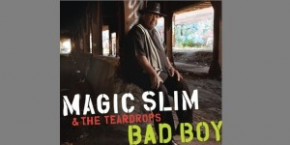
Magic Slim 1937-2013 by Jonny Meister

February 22, 2013
Magic Slim 1937-2013 by Jonny Meister

Few Philadelphia blues fans were aware that Magic Slim was in Philadelphia in February, in the intensive care unit at Thomas Jefferson University Hospital, where he died on February 20. The great bluesman had been hospitalized in January when he [...]

Read the full article →

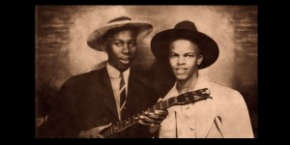
Possible New Photo Of Robert Johnson? by Jonny Meister

February 4, 2013
Possible New Photo Of Robert Johnson? by Jonny Meister

The British newspaper The Guardian is reporting that a new photograph of Robert Johnson has been authenticated. The photo shows him with longtime traveling companion Johnny Shines. The two known photos of Johnson, one which showed him with a cigarette [...]

Read the full article →

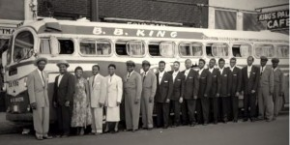
B. B. King “The Life Of Riley” – by Jonny Meister

January 22, 2013
B. B. King “The Life Of Riley” – by Jonny Meister

“The Life Of Riley” is an expression of uncertain origin, referring to a life of wealth, ease, and luxury. It’s been the title of several old radio and TV comedies and a movie starring William Bendix – and now, “The [...]

Read the full article →

Muddy Waters and The Rolling Stones Checkerboard Lounge by Jonny Meister

January 11, 2013
Muddy and Mick 1981 at The Checkerboard Lounge in Chicago

The release late in 2012 of the DVD “Muddy Waters & The Rolling Stones Checkerboard Lounge 1981″ once again brings to my mind the strange relationship between blues and rock ‘n’ roll. The great Muddy Waters is in his last [...]

Read the full article →

We Juke Up In Here nominated for Blues Music Award by Jonny Meister

December 13, 2012
Red's Lounge in scene from We Juke Up In Here

The film “We Juke Up in Here: Mississippi’s Juke Joint Culture At The Crossroads” has been nominated for a Blues Music Award (BMA) in the category of Blues DVD. This film, which looks at rhe current state of juke joints [...]

Read the full article →

Meet Jackson Mississippi’s Jarekus Singleton by Jonny Meister

December 9, 2012
Jarekus Singleton CD Heartfelt

Jarekus Singleton is a young bluesman from Jackson MS. He’s certainly a hometown favorite, but his name is starting to be known in other places. His influences are not strictly “Mississippi” artists, but he is an invigorating influence to the [...]

Read the full article →